Introduction
Marketing is no longer just about promoting a product—it is about reaching the right audience, at the right time, with the right message. Yet many businesses still struggle with one critical decision: Digital Marketing vs Traditional Marketing.
This confusion leads to poor investment decisions, wasted budgets, and slow business growth. If you don’t clearly understand the difference between digital and traditional marketing, you risk choosing strategies that don’t align with your business goals.
From my experience working with businesses across different industries, the biggest mistake is not the lack of effort—it is the lack of clarity. Many business owners rely on outdated methods or blindly follow trends without understanding what actually works.
In this guide, I will break down Digital Marketing vs Traditional Marketing in a practical, results-focused way so you can make smarter marketing decisions that directly impact your revenue.
Table of Contents
What is Digital Marketing?
Digital marketing refers to promoting products or services using online platforms, tools, and technologies. It focuses on targeting specific audiences, tracking performance, and optimizing campaigns for better results.
Unlike traditional methods, digital marketing allows businesses to operate with precision and scalability. Every action—whether it is a click, a website visit, or a purchase—can be tracked and analyzed.
Core Channels of Digital Marketing
Digital marketing includes multiple channels that work together to drive results:
- Search Engine Optimization (SEO) to rank higher on search engines
- Social Media Marketing to engage with audiences on platforms like Instagram and LinkedIn
- Pay-Per-Click Advertising (PPC) for instant traffic and leads
- Email Marketing for direct communication and retention
- Content Marketing to educate and attract potential customers
The biggest advantage here is control. Businesses can start with small budgets, test strategies, and scale what works. This is why the shift from online vs offline marketing is accelerating rapidly across industries.
What is Traditional Marketing?
Traditional marketing refers to offline promotional strategies that have been used for decades. These methods are designed to reach a broad audience through mass communication channels.
Traditional Marketing Examples
Common traditional marketing methods include:
- Television advertisements
- Radio commercials
- Newspaper and magazine ads
- Billboards and outdoor hoardings
- Flyers, brochures, and print materials
Traditional marketing is effective for creating brand awareness and reaching a large audience quickly. However, it lacks targeting precision and measurable performance.
When comparing Digital Marketing vs Traditional Marketing, this limitation becomes a major disadvantage in today’s competitive market.
Digital Marketing vs Traditional Marketing (Key Differences)
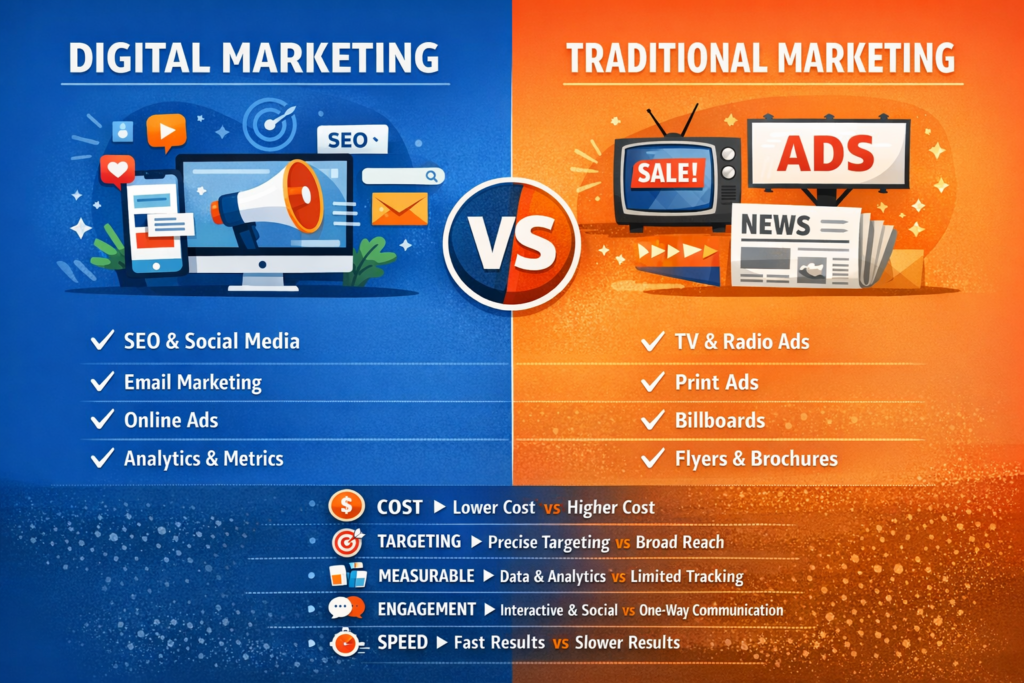
Understanding Digital Marketing vs Traditional Marketing becomes easier when you compare them based on key business factors that directly impact performance.
Cost
Digital marketing is highly flexible. Businesses can start with a small budget and gradually increase spending based on results. Campaigns can be paused, adjusted, or scaled at any time.
Traditional marketing, on the other hand, requires a significant upfront investment. Once a campaign is launched, changes are difficult and expensive.
For small and medium businesses, this cost difference is critical. Digital marketing provides more control over spending and reduces financial risk.
Reach
Digital marketing allows businesses to reach a global audience. With the right strategy, even a small business can attract customers from different cities or countries.
Traditional marketing is usually limited to specific geographic areas. A newspaper ad or billboard will only reach people in that location.
This makes digital marketing far more scalable compared to traditional methods.
Targeting
Targeting is one of the biggest differences in Digital Marketing vs Traditional Marketing.
Digital marketing allows you to target users based on:
- Age
- Location
- Interests
- Online behavior
Traditional marketing uses a broad approach, where messages are delivered to a general audience without precise segmentation.
Better targeting leads to higher conversion rates, making digital marketing more efficient.
Measurability
One of the biggest advantages of digital marketing is real-time tracking.
Businesses can measure:
- Website traffic
- Click-through rates
- Conversions
- Return on investment (ROI)
Traditional marketing lacks this level of transparency. It is difficult to determine how many people saw an ad or took action.
This makes digital marketing a data-driven approach, while traditional marketing relies more on assumptions.
Engagement
Digital marketing enables two-way communication. Customers can interact with brands through comments, messages, and reviews.
Traditional marketing is one-way communication. Businesses deliver a message, but there is no direct interaction.
Engagement plays a major role in building trust and long-term relationships with customers.
ROI (Return on Investment)
When comparing Digital Marketing vs Traditional Marketing, ROI is a decisive factor.
Digital marketing allows continuous optimization. Campaigns can be adjusted based on performance, leading to better results over time.
Traditional marketing does not offer the same flexibility. Once money is spent, it is difficult to improve performance.
This makes digital marketing more efficient in generating higher returns.
Flexibility
Digital marketing campaigns can be modified instantly. If something is not working, changes can be made in real time.
Traditional campaigns are fixed. Once an ad is printed or aired, it cannot be changed easily.
Flexibility reduces risk and improves overall campaign performance.
Advantages of Digital Marketing
Digital marketing has become the preferred choice for modern businesses because of its ability to deliver measurable and scalable results.
Key Benefits of Digital Marketing
- Cost-effective compared to traditional methods
- Highly targeted audience reach
- Real-time performance tracking
- Scalable campaigns based on results
Strategic Benefits
Digital marketing also provides long-term advantages:
- Builds strong online presence
- Improves brand visibility on search engines
- Generates consistent leads
- Enables data-driven decision-making
These benefits of digital marketing make it essential for businesses that want sustainable growth.
Advantages of Traditional Marketing
Despite the rise of digital platforms, traditional marketing still holds value in certain situations.
Key Benefits of Traditional Marketing
- Builds strong brand credibility
- Effective for local audiences
- Tangible presence through print materials
For example, a billboard in a high-traffic area can create strong brand recall. Similarly, newspaper ads can be effective for targeting local customers.
However, when analyzing Digital Marketing vs Traditional Marketing, traditional methods are more limited in terms of scalability and performance tracking.
Which Marketing Strategy is Better for Your Business?
The answer depends on your business goals, target audience, and budget.
Digital Marketing is Better If:
- You want measurable results
- You need targeted customer acquisition
- You have a limited budget
- You want faster and scalable growth
Traditional Marketing is Better If:
- You are targeting a local audience
- Your customers rely on offline media
- You want strong brand visibility in a specific area
In most cases, businesses benefit more from digital marketing due to its efficiency and flexibility.
When to Use a Combination of Both
The most effective approach is not choosing between Digital Marketing vs Traditional Marketing, but combining both strategically.
For example:
- Use traditional marketing for brand awareness
- Use digital marketing for lead generation and conversions
This combination creates a complete marketing funnel that covers both visibility and performance.
Common Mistakes Businesses Make
Many businesses fail to get results because of poor strategy rather than lack of effort.
Common Mistakes
- Choosing marketing channels without understanding the audience
- Spending heavily on traditional ads without tracking results
- Ignoring digital marketing due to lack of knowledge
- Expecting instant results without consistency
- Not optimizing campaigns based on performance
Avoiding these mistakes can significantly improve your marketing effectiveness.
Real-World Business Impact
Let’s look at how Digital Marketing vs Traditional Marketing plays out in real scenarios.
A local business relying only on newspaper ads may see limited growth because its reach is restricted. When the same business adopts digital marketing, it can target specific audiences and generate more leads at a lower cost.
Similarly, an e-commerce business depends heavily on digital marketing to scale. Without online channels, growth becomes nearly impossible.
These examples highlight why digital marketing has become essential in today’s business environment.
Future Trends in Marketing
The future clearly favors digital transformation.
Businesses are increasingly using:
- Data analytics to understand customer behavior
- Automation tools to scale campaigns
- Artificial intelligence for personalized marketing
Consumer behavior is also shifting. People spend more time online, research before purchasing, and expect personalized experiences.
While traditional marketing still exists, its role is evolving. It is now often used alongside digital strategies rather than as a standalone approach.
Understanding these trends helps businesses stay competitive in a rapidly changing market.
Why Hiring a Digital Marketing Professional is a Smart Investment
Many business owners try to manage marketing on their own. While this may seem cost-effective, it often leads to poor execution and wasted resources.
A professional digital marketer brings:
- Strategic planning
- Expertise in multiple channels
- Data-driven decision-making
- Better ROI through optimized campaigns
Instead of experimenting blindly, businesses can achieve faster and more predictable growth.
Conclusion
Understanding Digital Marketing vs Traditional Marketing is essential for making informed business decisions.
Digital marketing offers better targeting, lower costs, and measurable results, making it the preferred choice for most businesses today. Traditional marketing still has its place, especially for brand awareness and local reach, but it works best when combined with digital strategies.
If your goal is long-term growth, higher ROI, and stronger customer engagement, investing in digital marketing is no longer optional—it is necessary.
Businesses that adapt to modern marketing strategies will continue to grow, while those that rely only on traditional methods risk falling behind.
The smartest move is to use the strengths of both approaches while focusing on strategies that deliver measurable results.
Cost Breakdown: Digital Marketing vs Traditional Marketing in India
When businesses evaluate Digital Marketing vs Traditional Marketing, cost becomes a deciding factor. However, most business owners don’t fully understand how pricing differs between the two.
In digital marketing, you can start with a relatively small budget and scale gradually. For example, social media ads or search engine campaigns allow you to control spending daily. This flexibility makes digital marketing accessible even for startups and small businesses.
On the other hand, traditional marketing often requires a large upfront investment. Television ads, print media, and billboards come with fixed costs that cannot be easily adjusted once committed.
This is why, in the debate of Digital Marketing vs Traditional Marketing, digital marketing is often the preferred choice for businesses looking for cost efficiency and better control over their budgets.
Another important point is cost efficiency over time. Digital campaigns can be optimized continuously, reducing wasted spending. Traditional campaigns lack this adaptability, which can lead to higher long-term costs with uncertain returns.
How to Choose the Right Strategy Based on Business Type
Understanding Digital Marketing vs Traditional Marketing is not enough—you must align the strategy with your business model.
For service-based businesses such as consultants, agencies, or freelancers, digital marketing is essential. These businesses rely on lead generation, online visibility, and targeted outreach, which traditional marketing cannot deliver effectively.
For retail businesses with physical locations, a mix of both strategies works best. Traditional marketing can drive local awareness, while digital marketing converts that attention into actual customers.
Large brands often use both approaches together. They leverage traditional media for mass visibility and digital channels for engagement and performance tracking. This balanced approach ensures maximum impact.
When analyzing Digital Marketing vs Traditional Marketing, the key is not choosing one blindly but selecting the right mix based on your audience and objectives.
Final Insight: Why Digital Marketing is Dominating
The shift from traditional to digital is not a trend—it is a transformation. Businesses are moving toward digital platforms because that is where customers are spending their time.
In the ongoing comparison of Digital Marketing vs Traditional Marketing, digital continues to dominate because it offers measurable results, better targeting, and higher ROI. Businesses that adapt to this shift gain a significant competitive advantage.
However, ignoring traditional marketing completely can also be a mistake. The most successful strategies integrate both approaches intelligently.
Ultimately, the goal is not to choose sides in Digital Marketing vs Traditional Marketing, but to use each method where it performs best.